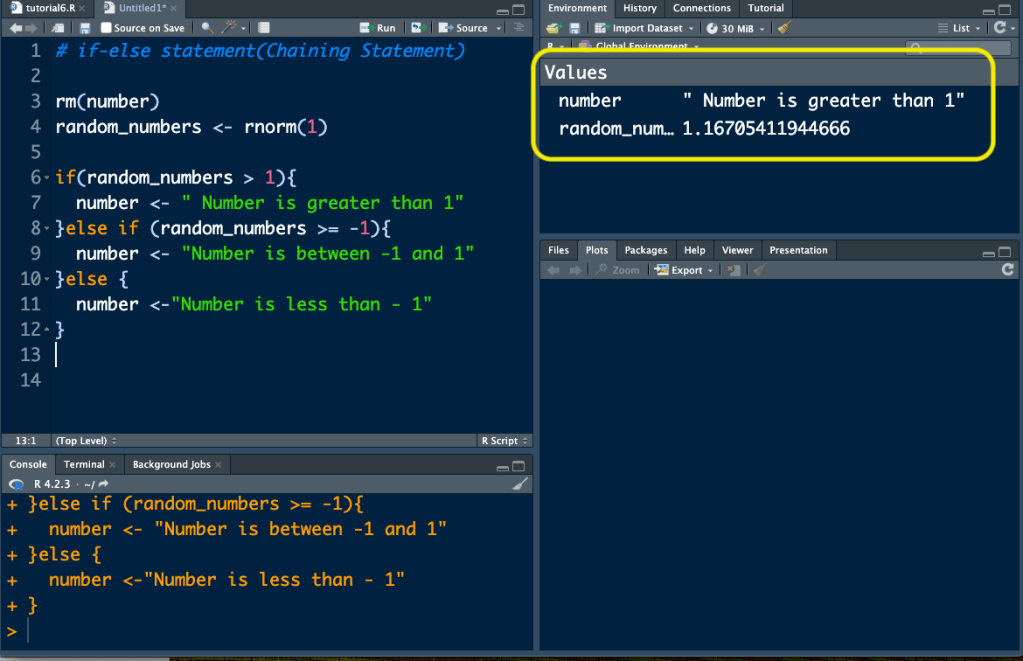
This R program involves an if-else statement with chained conditions to check multiple cases:
rm(number): This command removes any existing object named “number” from the R environment.
random_numbers <- rnorm(1): A single random number is generated from a standard normal distribution using thernorm()function and stored in the variablerandom_numbers.
- The program checks the value of
random_numbersagainst multiple conditions:- If
random_numbersis greater than 1:number <- "Number is greater than 1": The variablenumberis assigned the string value “Number is greater than 1”.
- If
- Else, if
random_numbersis greater than or equal to -1:number <- "Number is between -1 and 1": The variablenumberis assigned the string value “Number is between -1 and 1”.

- If none of the above conditions are met (i.e.,
random_numbersis less than -1):number <- "Number is less than -1": The variablenumberis assigned the string value “Number is less than -1”.

In summary, this program generates a random number from a normal distribution and categorizes it into one of three ranges: greater than 1, between -1 and 1 (inclusive), or less than -1, based on the specified conditions. Chained if-else statements in R, also known as if-else-if statements, allow you to check multiple conditions sequentially.
 Academic Brain Solutions
Leave a comment